


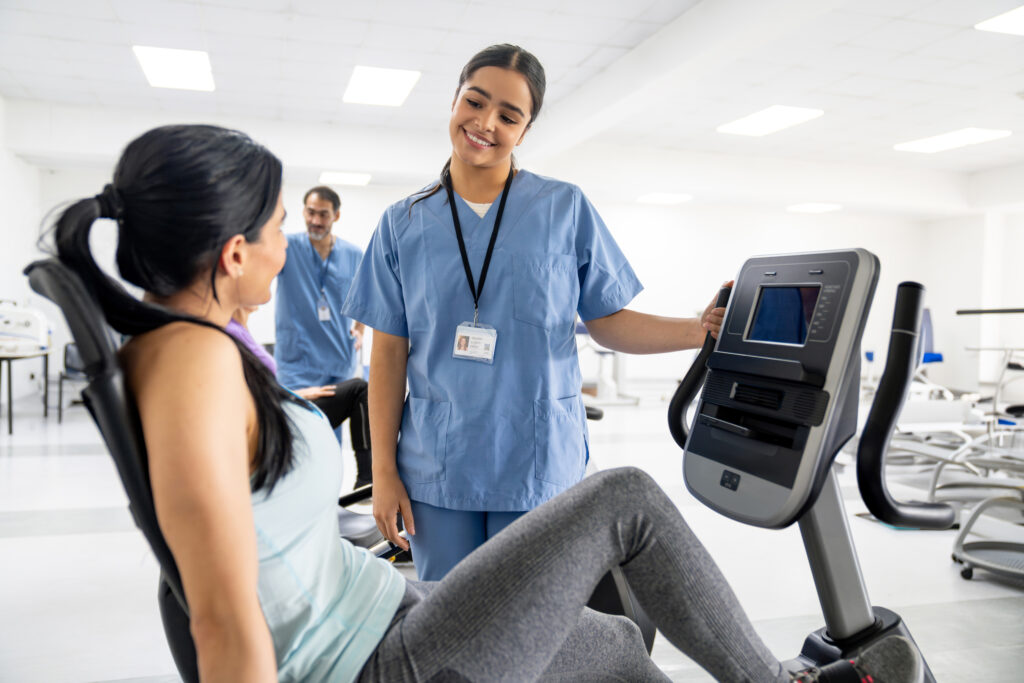
How Femina Physical Therapy Helps Women in Los Angeles Rebuild Tolerance When Standing Up Is the Hardest Part of the Day
If you have been told your labs are “normal,” that you are “just anxious,” or that you simply need to push harder, and you are still lightheaded every time you stand up, this guide is written for you. Many people who arrive at Femina Physical Therapy for POTS physical therapy in Los Angeles have spent years being dismissed before anyone took their symptoms seriously. The exhaustion after a shower, the racing heart in the grocery line, the brain fog that erases the middle of your day. These are physiological, not a matter of willpower. This page explains what postural orthostatic tachycardia syndrome (POTS) and orthostatic intolerance (OI) are, what the research does and does not support about physical therapy, and how care works across our Sherman Oaks, Pasadena, and Beverly Hills offices.
What POTS and orthostatic intolerance actually are
POTS is defined by a sustained heart-rate increase of at least 30 beats per minute within ten minutes of standing, without the significant blood pressure drop that defines orthostatic hypotension. For ages 12 to 19, the threshold is 40 beats per minute[12]. Orthostatic intolerance, which simply means trouble staying upright, is the broader umbrella: not everyone with debilitating symptoms on standing meets the POTS heart-rate threshold, yet the impact on daily life can be just as severe.
POTS is not one single problem with one single cause. Doctors describe it as having several different causes at once (what literature describes as ‘mechanistically heterogeneous’). Known contributors include low blood volume, blood pooling in the legs, loss of fitness from being inactive (termed deconditioning), damage to the small nerves that control automatic body functions (termed small-fiber autonomic neuropathy), a body that runs high on adrenaline (termed hyperadrenergic), and problems driven by the immune system (termed immune-mediated)[6]. In much of the literature the fast heart rate is seen as the body trying to make up for that drop (this is termed compensatory): it is defending the amount of blood the heart pumps each minute (termed cardiac output) when less blood returns to the heart (termed venous return) and each heartbeat pushes out less blood (termed stroke volume) on standing[6]. The racing heart is often a symptom of the underlying circulatory challenge, not the root problem itself.
Why physical therapy is a first-line approach
This is the part that surprises people, because exercise can sound like the opposite of what a body in this state can tolerate. The evidence, though, is unusually strong for a condition this complex.
A landmark randomized controlled trial compared structured exercise training with the beta-blocker propranolol. Both lowered standing heart rate, but exercise improved symptoms, blood flow (termed hemodynamics), and quality of life in ways the medication did not[1]. A separate randomized controlled trial found that a semi-supervised, personalized exercise program significantly outperformed standard of care on aerobic fitness, exercise tolerance, and orthostatic-intolerance symptom scores[2]. A 2025 systematic review of 21 randomized controlled trials found trial support for exercise training, while noting that most POTS trials are small[3].
The key detail is how the exercise is structured. Established programs begin lying down or seated (lying-down exercise is termed recumbent), on a recumbent bike, a rowing machine, or the floor, and build up slowly toward standing activity as your tolerance allows[1]. This is not “push through it.” It is the opposite: a carefully graded entry point that respects a body that cannot yet tolerate standing work.
The deconditioning loop, and why the starting point is key
This loss of fitness, called deconditioning, both results from and worsens POTS. Long bed rest and spaceflight cause the same kind of fitness loss and fast heart rate on standing[4]. The trap is circular: symptoms limit activity, and inactivity worsens the symptoms. Breaking that loop does not require greater effort. It requires an accessible starting point that does not trigger a crash. That is what a graded, recumbent-first program is built to provide. Read how a POTS exercise program is structured, step by step.
The venous-return rationale for lower-body work
Your calf and thigh muscles act as a pump that pushes blood back up to the heart, working against the blood pooling that drives standing symptoms[13]. This is why lower-body strength work is a cornerstone of POTS exercise protocols. Women with POTS have also been found to have stiffer large arteries and more blood collecting in the calves on standing, while the inner lining of the blood vessels (termed endothelial function) works normally[5]. That pooling is part of why rebuilding the muscular pump is a reasonable therapeutic target.
One brief note on a related question we are often asked: blood flow restriction (BFR) training is sometimes raised as a way to build lower-body strength at low loads. We cover BFR and POTS in full in a dedicated article rather than repeating it here.
The whole-body picture: hypermobility, pelvic health, and chronic pain in women
POTS rarely travels alone, and for the women we treat the overlaps are central rather than incidental. Trouble with the autonomic nervous system, the part of the body that runs automatic tasks like heart rate (termed autonomic dysfunction), including orthostatic intolerance, is linked with hypermobile Ehlers-Danlos syndrome (hEDS, a condition that makes the joints very loose and flexible) and related hypermobility disorders, along with chronic pain and a raised sensitivity to pain throughout the body (termed generalized hyperalgesia)[7]. Hypermobility is a condition that often shows up alongside POTS, and many patients have hEDS, chronic pain, or both[7]. Mast cell activation, when certain immune cells release too many chemicals such as histamine, is also linked with POTS in some patients, especially those with flushing and allergy-like symptoms[8]. We treat this as one interconnected picture. See how the hEDS-POTS overlap works, and how the POTS-MCAS overlap fits in.
Because POTS predominantly affects women and often emerges around puberty, we also address it across life stages and hormonal changes: POTS in pregnancy, hormonal and menstrual-cycle influences on POTS, and POTS in adolescents and young women.
There is also a pelvic-health thread that a women’s-health practice like Femina PT is positioned to see. Bladder symptoms such as sudden urges to go and waking at night to urinate (termed nocturia) are seen in women with POTS[9], and the hypermobility that so often accompanies POTS is itself linked with pelvic floor problems, a pelvic organ dropping from its normal position (termed prolapse), and pelvic pain, with pelvic floor physical therapy the most commonly recommended treatment in that group[10]. Pelvic floor muscle training is, separately, a first-line, research-supported treatment for urinary incontinence in women[11].
To clarify, no published clinical trials have yet tested pelvic floor physical therapy specifically in a POTS or orthostatic-intolerance population. The individual links above are supported; connecting them is our clinical reasoning. Our practice uses the evidence to guide our clinical care of patients, which is necessary to support the complex diagnoses we see when the research has not caught up yet. Read the full pelvic-health picture for women with POTS.
What care looks like at Femina Physical Therapy
Every plan begins with a comprehensive evaluation: symptom history, triggers, functional baseline, current medications, and co-occurring diagnoses. From there, Femina PT sessions are built around how your body works rather than a fixed timeline:
- Fitness sessions begin lying on your back, partly reclined (termed semi-recumbent) or seated and progress upright only as tolerance allows.
- The fitness portion of the session runs about 15-20 minutes, respecting your limited energy (sometimes called your ‘energy envelope’) and the symptoms that can flare after activity (termed post-exertional symptoms). The rest of the 55-minute visit covers other physical therapy treatment and rest breaks as needed.
- Heart rate and symptoms are monitored throughout, with immediate adjustment as needed.
- A recovery period is built in before standing.
- Assistance coordinating your physician’s hydration and sodium plan into your daily routine and exercise.
- Progression is driven entirely by your response, with no pushing through symptoms.
Physical therapy does not replace your cardiologist or autonomic specialist; it works alongside them. Here is what PT does and does not replace.
Where we treat POTS in Los Angeles
Femina Physical Therapy sees patients for POTS and orthostatic intolerance at three physical Los Angeles-area offices: Sherman Oaks (San Fernando Valley), Pasadena (San Gabriel Valley), and Beverly Hills. Between them they cover much of greater Los Angeles, including the Westside and the Valley. If you are searching for POTS physical therapy near you in LA, any of the three can complete a full evaluation and build your program.
Start where you are
You do not need to be able to stand for an hour, or walk into the clinic without symptoms, to begin. The entire point of an evidence-informed, graded program is that it meets a body where it is today and moves gently and measurably from there. Our goal is to reduce your symptom burden and improve your quality of life, applying the approaches the research best supports.
✅ This is what evidence-informed care looks like: we tell you what the research shows, what it does not yet show, and why an approach is still worth trying for you. Then we measure whether it is working for your body specifically.
“You do not need to walk in symptom-free to begin. An evidence-informed program meets your body where it is today.”
📍 Femina Physical Therapy treats POTS and orthostatic intolerance across Los Angeles, with offices in Sherman Oaks, Pasadena, and Beverly Hills. Telehealth and Coaching consultations are available for patients whose symptoms make travel difficult.
FAQ — PEOPLE ALSO ASK
Yes, when it is structured correctly. Evidence-supported POTS programs begin lying down (recumbent) or seated and progress toward upright activity only as your tolerance allows, with heart-rate and symptoms monitored throughout. The goal is a graded entry point that avoids triggering a crash, not pushing through symptoms.
A regular plan usually assumes you can already tolerate upright exercise. POTS physical therapy starts horizontal, prioritizes lower-body and core work that helps push blood back to the heart, keeps the fitness portion of each session short to respect your energy limits, and adjusts in real-time to your heart rate and symptom response.
Yes. Hypermobility, chronic pain, and pelvic floor symptoms frequently overlap with POTS in women, and as a women’s-health practice we treat them as one connected picture rather than separate problems handled in isolation.
Femina Physical Therapy treats POTS and orthostatic intolerance at three physical offices: Sherman Oaks, Pasadena, and Beverly Hills. Each location can complete a full evaluation and build your individualized program.
No responsible provider can promise a cure. What the research supports is that structured, graded exercise can improve symptoms, fitness, and quality of life for many people with POTS. We apply those evidence-informed approaches with the goal of reducing your symptom burden.
>> Living with POTS in Los Angeles? There is more available to you than you have been told. Book your evaluation at Femina Physical Therapy.
References (Peer-Reviewed Sources)
[1] (Class A) Fu Q, VanGundy TB, Shibata S, Auchus RJ, Williams GH, Levine BD. Exercise training versus propranolol in the treatment of the postural orthostatic tachycardia syndrome. Hypertension. 2011;58(2):167-175. [pubmed.ncbi.nlm.nih.gov/21690484]
[2] (Class A) Semi-supervised exercise training program more effective for individuals with POTS in a randomized controlled trial. (PMC10751269) [ncbi.nlm.nih.gov/pmc/articles/PMC10751269]
[3] (Class A) Kwok CS, et al. The evidence for treatments for postural orthostatic tachycardia syndrome: a systematic review of 21 randomized controlled trials, 2000-2023. Trends Cardiovasc Med. 2025;35(8):517-527. [pubmed.ncbi.nlm.nih.gov/40653179]
[4] (Class C) Joyner MJ, Masuki S. POTS versus deconditioning: the same or different? Clin Auton Res. 2008;18(6):300-307. [pmc.ncbi.nlm.nih.gov/articles/PMC3770293]
[5] (Class C) Central arterial stiffness, flow-mediated dilation and venous function in POTS. Am J Physiol Heart Circ Physiol. 2026 Jan 1;330(1):H89-H99. [pubmed.ncbi.nlm.nih.gov/41297031]
[6] (Class C) POTS: when dysautonomia misleads – a mechanistic argument for compensatory orthostatic tachycardia. Front Neurol. 2026. [frontiersin.org/journals/neurology/articles/10.3389/fneur.2026.1806502]
[7] (Class C) Symptomatic Joint Hypermobility: the hypermobile type of Ehlers-Danlos syndrome and the hypermobility spectrum disorders. 2019. [pubmed.ncbi.nlm.nih.gov/31582002]
[8] (Class C) Mast cell activation disorder and postural orthostatic tachycardia syndrome: a clinical association. J Am Heart Assoc. 2021. [pubmed.ncbi.nlm.nih.gov/34398691]
[9] (Class C) Kaufman MR, et al. Overactive bladder and autonomic dysfunction: lower urinary tract symptoms in females with postural tachycardia syndrome. Neurourol Urodyn. 2017;36(3):610-613. [pubmed.ncbi.nlm.nih.gov/26859225]
[10] (Class C) Joint hypermobility syndrome for the urogynaecologist – a narrative review. 2026. [pubmed.ncbi.nlm.nih.gov/41512700]
[11] (Class A) Dumoulin C, Cacciari LP, Hay-Smith EJC. Pelvic floor muscle training versus no treatment, or inactive control treatments, for urinary incontinence in women. Cochrane Database Syst Rev. 2018;10(10):CD005654. [cochranelibrary.com/cdsr/doi/10.1002/14651858.CD005654.pub4/full]
[12] (Class C) Sheldon RS, Grubb BP 2nd, Olshansky B, et al. 2015 Heart Rhythm Society expert consensus statement on the diagnosis and treatment of postural tachycardia syndrome, inappropriate sinus tachycardia, and vasovagal syncope. Heart Rhythm. 2015;12(6):e41-e63. [doi.org/10.1016/j.hrthm.2015.03.029]
[13] (Class C) Stewart JM, Medow MS, Montgomery LD, McLeod K. Decreased skeletal muscle pump activity in patients with postural tachycardia syndrome and low peripheral blood flow. Am J Physiol Heart Circ Physiol. 2004;286(3):H1216-H1222. [doi.org/10.1152/ajpheart.00738.2003]
Related Reading: POTS & Orthostatic Intolerance at Femina Physical Therapy
→ Recumbent to Upright: How a POTS Exercise Program Is Structured
→ Pacing, Energy Envelopes, and Post-Exertional Symptom Management in POTS
→ The hEDS-POTS Overlap: When Hypermobility and Dysautonomia Occur Together
→ Hydration, Sodium, and Compression: The Non-Exercise Foundations for POTS
→ Working With Your Cardiologist or Autonomic Specialist: What PT Does and Doesn’t Replace
→ POTS After COVID: Post-Viral Dysautonomia and Rehabilitation
→ POTS, Dysautonomia, and the Pelvic Floor: Bladder, Pelvic Pain, and Women’s Pelvic Health
→ POTS in Pregnancy: What to Expect, and How Physical Therapy Supports You
→ Hormonal and Menstrual-Cycle Influences on POTS
→ The POTS-MCAS Overlap: Mast Cell Activation and Dysautonomia
→ POTS in Adolescents and Young Women: Recognizing It and Rebuilding
Medical disclaimer: This article is for informational purposes only and is not intended as medical advice. Always consult your medical doctor before beginning this or any program that may affect your health. Reading this article does not create a patient relationship with Femina Physical Therapy.