


What Is Documented About Cycle-Related Symptom Changes, and What the Evidence Does Not Yet Show
Part of the Femina PT POTS & Orthostatic Intolerance Series | Complete Guide: POTS & Orthostatic Intolerance Physical Therapy in Los Angeles
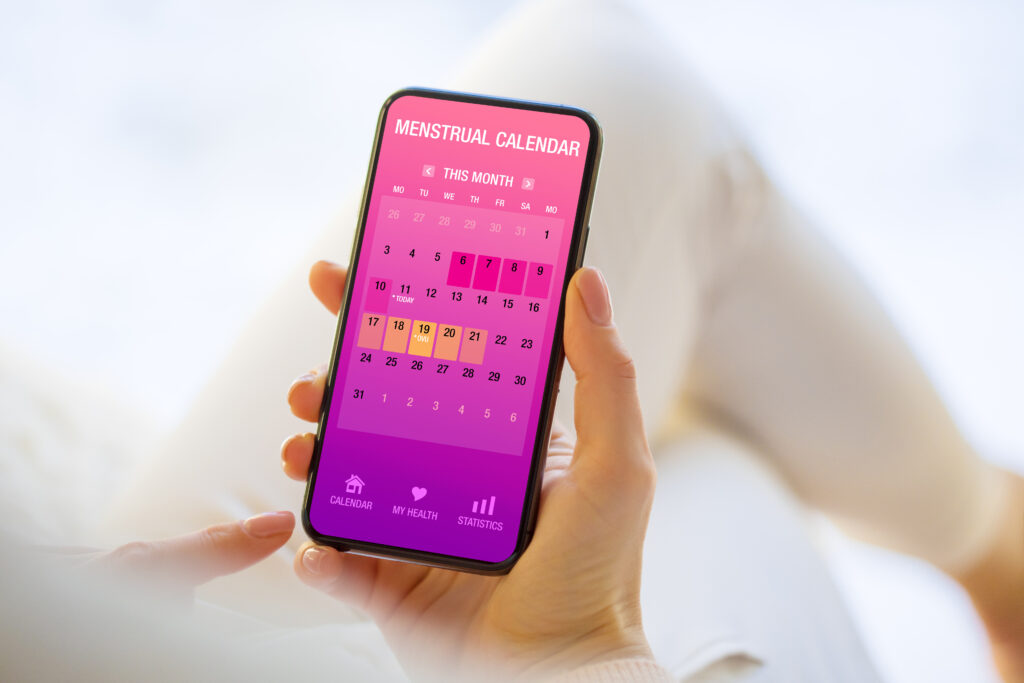
If you have noticed that your POTS symptoms seem to track your menstrual cycle, worse in the days before or during your period, you are not imagining a pattern, and you are far from the only one who reports it. The relationship between POTS and the menstrual cycle is worth understanding, and it is more nuanced than it may first appear. Below we discuss what is documented, and what is not.
What women notice, and what the studies show
A lot of women with POTS notice their symptoms rise and fall with their cycle. In one review of 81 women whose POTS was confirmed on a tilt-table test (a test that checks your heart rate and blood pressure as the table is tilted upright), 34 said their symptoms got worse during their period, especially lightheadedness, near-fainting (presyncope), and fatigue. Some felt better when their periods were stopped with birth control[1]. Other research points the same way: women with POTS often feel worse in the days before their period, or in the early part of their cycle, when estrogen and progesterone are at their lowest[2].
One carefully controlled study tracked heart rate and blood pressure during long periods of standing and found no meaningful difference from one phase of the cycle to the next. Its conclusion was that hormone shifts don’t cause POTS, though they may affect how well your body handles standing[3].
In summary, cycle-related ups and downs in how you feel are common and well documented. But hard evidence that hormones are driving POTS itself is limited and mixed. Both of those things are true, and we use both to guide your care.
The puberty connection
The hormonal thread also appears at the other end. Young women tend to tolerate being upright less well and develop POTS more often, and pubertal hormonal changes have been proposed as one contributor to that susceptibility[4]. We cover POTS in adolescents and young women separately.
Hormonal management is a physician’s call: here’s what PT does
Any hormonal strategy, such as using contraception to suppress menstruation, is a decision for your gynecologist or physician, individualized to you; some women report benefit, but it is not something a physical therapist prescribes or manages[1]. What Femina Physical Therapy can do is practical: help you track your own pattern, then adjust pacing and the graded exercise program[5] around the predictable harder windows of your cycle, so a bad week is planned for rather than a repeated ambush. No trials have tested physical therapy aimed specifically at cycle-related POTS flares, so we frame this as pattern-aware, evidence-informed care rather than a proven protocol.
✅ This is what evidence-informed care looks like: we tell you what the research shows, what it does not yet show, and why an approach is still worth trying for you. Then we measure whether it is working for your body specifically.
“Cycle-related ups and downs are common and documented. What drives them is still an open question.”
📍 Femina Physical Therapy treats POTS and orthostatic intolerance across Los Angeles, with offices in Sherman Oaks, Pasadena, and Beverly Hills. Telehealth and Coaching consultations are available for patients whose symptoms make travel difficult.
FAQ — PEOPLE ALSO ASK
Many women with POTS report worse symptoms premenstrually and during menstruation, commonly lightheadedness, near-fainting (presyncope), and fatigue. This cyclical symptom pattern is documented in clinical literature, though it is based largely on self-report and record reviews rather than large controlled studies.
The evidence says no. A controlled study found heart-rate and blood-pressure responses to standing did not vary across cycle phases and concluded POTS is not caused by hormone fluctuations, even though those fluctuations may affect how the body compensates. Symptom reports vary while the objective picture is mixed.
Some women report improvement when menstruation is suppressed with contraception, but this is a physician or gynecologist decision, individualized to you. It is not something a physical therapist prescribes. Discuss the risks and benefits with the doctor managing your care.
A physical therapist can help you track your pattern and then plan pacing and your graded exercise around the predictable harder days of your cycle. No trials test PT specifically for cyclical POTS, so this is pattern-aware, evidence-informed care rather than a proven protocol.
>> Living with POTS in Los Angeles? We can plan around the harder weeks of your cycle. Book your evaluation at Femina Physical Therapy.
References (Peer-Reviewed Sources)
[1] (Class C) Menstrual cycle variability in symptoms of postural orthostatic tachycardia syndrome. Heart Lung Circ. 2022. [heartlungcirc.org/article/S1443-9506(22)00628-X/fulltext]
[2] (Class C) Peggs KJ, et al. Gynecologic disorders and menstrual cycle lightheadedness in postural tachycardia syndrome. Int J Gynaecol Obstet. 2012. [sciencedirect.com/science/article/abs/pii/S0020729212002615]
[3] (Class C) Menstrual cycle affects renal-adrenal and hemodynamic responses during prolonged standing in POTS. Found no HR/BP variation across cycle phases. Hypertension. 2010. [ahajournals.org/doi/10.1161/hypertensionaha.110.151787]
[4] (Class C) Pubertal hormonal changes and the autonomic nervous system: potential role in pediatric orthostatic intolerance. (PMC6861527) [ncbi.nlm.nih.gov/pmc/articles/PMC6861527]
[5] (Class A) Fu Q, VanGundy TB, Shibata S, Auchus RJ, Williams GH, Levine BD. Exercise training versus propranolol in the treatment of the postural orthostatic tachycardia syndrome. Hypertension. 2011;58(2):167-175. [pubmed.ncbi.nlm.nih.gov/21690484]
Related Reading: POTS & Orthostatic Intolerance at Femina Physical Therapy
→ POTS in pregnancy: what to expect and how PT supports you
→ POTS in adolescents and young women
→ Complete Guide: POTS & Orthostatic Intolerance Physical Therapy in Los Angeles (Pillar)
Medical disclaimer: This article is for informational purposes only and is not intended as medical advice. Always consult your medical doctor before beginning this or any program that may affect your health. Reading this article does not create a patient relationship with Femina Physical Therapy.