


The Fluid, Salt, and Compression Basics That Make POTS Rehabilitation Possible, Set With Your Physician
Part of the Femina PT POTS & Orthostatic Intolerance Series | Complete Guide: POTS & Orthostatic Intolerance Physical Therapy in Los Angeles
Exercise is the most studied physical therapy tool for POTS, but it does not work in a vacuum. The daily foundations of fluid, salt, and compression are an important piece of a POTS exercise program. These are simple, low-cost strategies, and they should always be coordinated with your physician.
Why hydration and sodium come up in almost every POTS conversation
Several known drivers of POTS involve low blood volume and blood pooling in the legs[1]. Extra fluid and salt can help increase the amount of blood circulating in your body (blood volume), so more blood returns to your heart when you stand. Because the right targets depend on your specific POTS subtype, other medical conditions, and medications, Femina Physical Therapy helps fit your physician’s hydration and sodium plan into your daily routine and exercise rather than issuing one-size-fits-all numbers. Always talk with your doctor before changing your fluid or salt intake. Sodium loading is not appropriate for everyone, particularly with certain heart or kidney conditions.
Compression and the venous-return problem
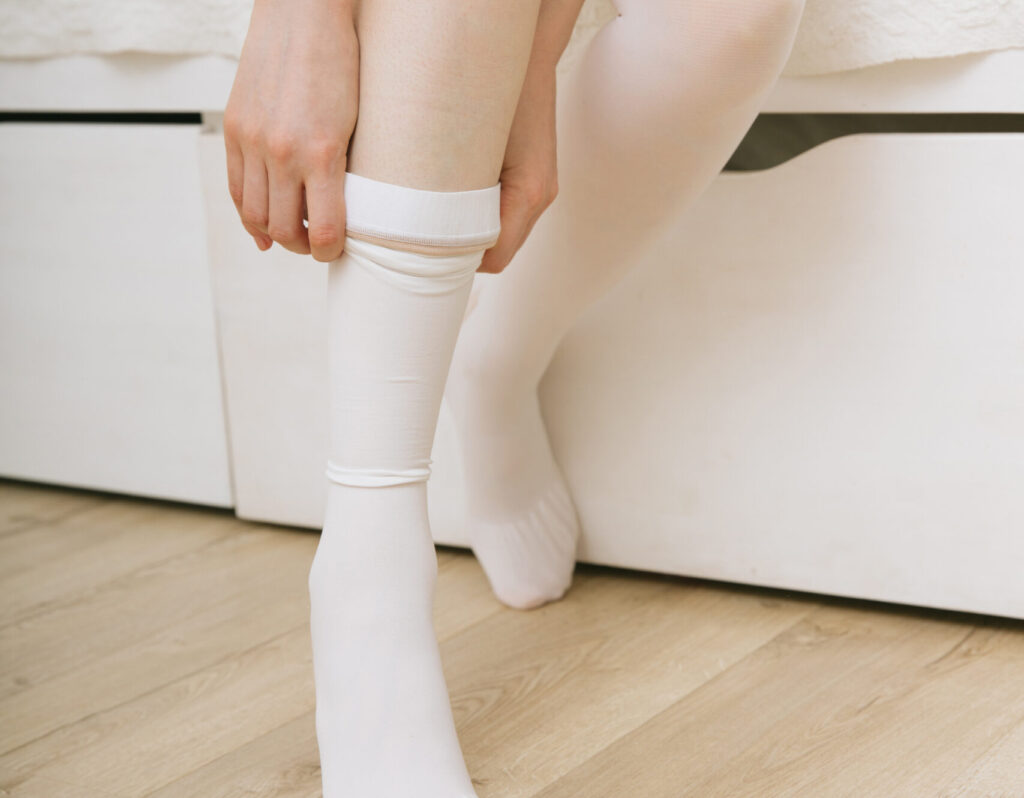
Your calf and thigh muscles act as a pump that pushes blood back up to the heart (venous return), working against the pooling that drives standing symptoms (orthostatic symptoms)[2]. Compression garments approach the same problem from the outside, reducing the volume of blood that settles in the legs and abdomen when you are upright. Waist-high compression is often discussed as more effective than knee-high for this purpose. Your care team can help you choose the right type.
How the foundations support the exercise program
Think of fluid, salt, and compression as the conditions that make rehabilitation possible. When circulating volume is better supported and pooling is reduced, the graded, lying-down-first exercise program[3] that rebuilds your body’s own muscular pump becomes more tolerable and more effective. See how the exercise progression is structured. Your medical team leads on these foundations. Here is how PT collaborates with your physician.
At Femina PT, we integrate these foundations into your plan while keeping your physician firmly in the driver’s seat for the medical side.
“Think of fluid, salt, and compression as the conditions that make rehabilitation possible.”
📍 Femina Physical Therapy treats POTS and orthostatic intolerance across Los Angeles, with offices in Sherman Oaks, Pasadena, and Beverly Hills. Telehealth and Coaching consultations are available for patients whose symptoms make travel difficult.
FAQ — PEOPLE ALSO ASK
There is no universal number, and the right target depends on your POTS subtype, other conditions, and medications. Fluid and sodium strategies are used to support blood volume, but they must be set with your physician. Sodium loading is not safe for everyone, especially with some heart or kidney conditions.
Compression addresses the blood pooling that drives orthostatic symptoms by reducing how much blood settles in the legs and abdomen when upright. Waist-high compression is often considered more effective than knee-high for this purpose. It works best combined with exercise and, where appropriate, fluid and sodium strategies.
No. Fluid, salt, and compression are foundations that make activity more tolerable, but graded exercise training is the intervention with the strongest randomized evidence for improving POTS symptoms and quality of life. The foundations support the exercise program rather than replacing it.
Because sodium and fluid targets are a medical decision. They interact with your diagnosis, medications, and other conditions, and are not appropriate at the same level for everyone. A responsible PT integrates these foundations into your plan while your physician leads on the specifics.
>> Living with POTS in Los Angeles? Small daily foundations make rehabilitation possible. Book your evaluation at Femina Physical Therapy.
References (Peer-Reviewed Sources)
[1] (Class C) POTS: when dysautonomia misleads – a mechanistic argument for compensatory orthostatic tachycardia. Front Neurol. 2026. [frontiersin.org/journals/neurology/articles/10.3389/fneur.2026.1806502]
[2] (Class C) Stewart JM, Medow MS, Montgomery LD, McLeod K. Decreased skeletal muscle pump activity in patients with postural tachycardia syndrome and low peripheral blood flow. Am J Physiol Heart Circ Physiol. 2004;286(3):H1216-H1222. [doi.org/10.1152/ajpheart.00738.2003]
[3] (Class A) Fu Q, VanGundy TB, Shibata S, Auchus RJ, Williams GH, Levine BD. Exercise training versus propranolol in the treatment of the postural orthostatic tachycardia syndrome. Hypertension. 2011;58(2):167-175. [pubmed.ncbi.nlm.nih.gov/21690484]
Related Reading: POTS & Orthostatic Intolerance at Femina Physical Therapy
→ How a POTS exercise program is structured, recumbent to upright
→ Working with your cardiologist: what PT does and doesn’t replace
→ Complete Guide: POTS & Orthostatic Intolerance Physical Therapy in Los Angeles (Pillar)
Medical disclaimer: This article is for informational purposes only and is not intended as medical advice. Always consult your medical doctor before beginning this or any program that may affect your health. Reading this article does not create a patient relationship with Femina Physical Therapy.