


Bladder, Nocturia, and Pelvic Pain in Women With POTS: What the Evidence Shows
Part of the Femina PT POTS & Orthostatic Intolerance Series | Complete Guide: POTS & Orthostatic Intolerance Physical Therapy in Los Angeles
This is the part of the POTS picture that a general clinic often misses and a women’s-health practice like Femina PT is built to see. Bladder urgency, needing the bathroom all night, pelvic pain, pain with intimacy: for many women with POTS, these are not separate problems. They are part of the same story, and there is a physiological basis for the connection.
What the evidence shows, and where it stops
Here is what is documented, and what is not.
What is supported:
- Bladder symptoms, including sudden urges, frequent trips, and especially waking at night to urinate (nocturia), are documented in women with POTS, with nocturia having the greatest negative impact on quality of life in a pilot study[1].
- Lower urinary tract dysfunction is documented in dysautonomia more broadly, predominantly in females, with an overactive bladder muscle (detrusor overactivity) a common finding and most patients managed successfully with medical or physical therapy[2].
- Hypermobility, which very often shows up alongside POTS, is linked with pelvic floor problems, a pelvic organ dropping down from its normal position (pelvic organ prolapse), bladder symptoms, and pain in the genital and pelvic area (genito-pelvic pain), with pelvic floor physical therapy the most commonly recommended intervention in that population[3][4][5].
- Hypermobility and POTS co-occur frequently; in one community-based study of women with hEDS/HSD, a majority (58%) reported a POTS diagnosis[6].
- Pelvic floor muscle training is, in the general female population, a first-line treatment for urinary incontinence, with a Cochrane systematic review finding women with stress incontinence roughly eight times more likely to report cure after training[7].
What is not established: As of October 2026, no published clinical trials have tested pelvic floor physical therapy specifically in a POTS or orthostatic-intolerance population. Each link in the chain above is individually supported, but connecting them to conclude that pelvic floor physical therapy will resolve pelvic symptoms because you have POTS is our clinical reasoning. The trials that would test this in this specific population do not yet exist. What we can say is that the reasoning is clinically logical and the individual pieces are evidence-based.
As thought leaders in our field, we are clear about which parts are established and which are careful clinical reasoning.
To clarify, physical therapy for POTS itself is on solid ground. The structured, exercise-based approach has strong research behind it, which you can read about in our main POTS physical therapy guide. What hasn’t been studied yet is pelvic floor therapy specifically for POTS. So the POTS side of your care rests on well-supported treatment, and the pelvic floor side is where we’re applying clinical judgment and reasoning.
Why the connection is physiologically plausible
Normal bladder and pelvic floor function depend on the autonomic nervous system, so it is unsurprising that an autonomic disorder like POTS shows up as bladder symptoms[2]. Layer in the loose, stretchy connective tissue of hypermobility, which is associated with pelvic floor dysfunction and prolapse[3], and you have two independent routes to the same pelvic symptoms, often in the same woman.
How Femina Physical Therapy approaches it
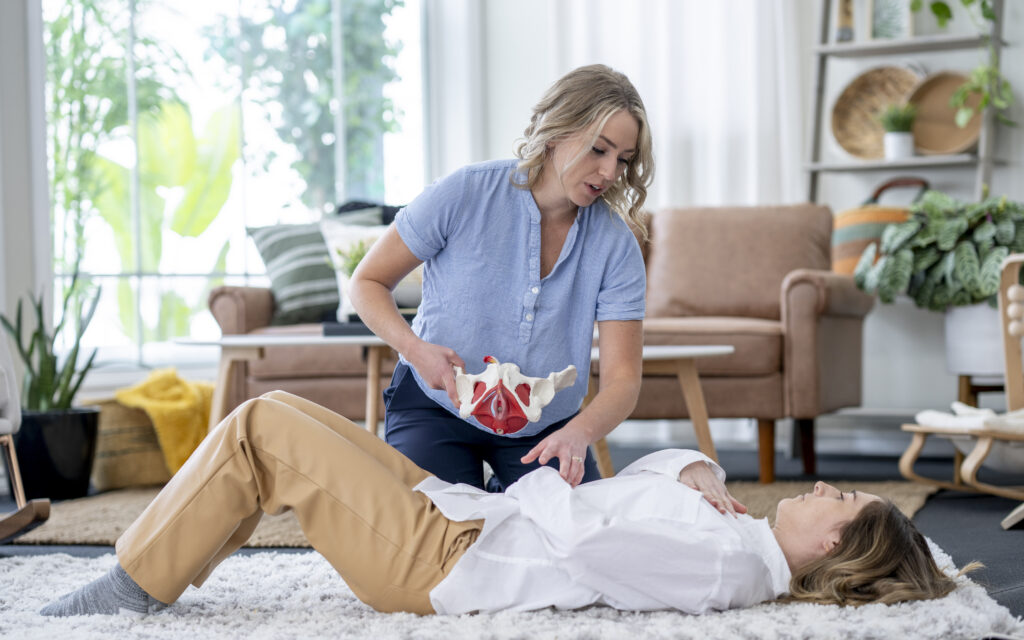
As a women’s pelvic-health practice, Femina Physical Therapy can evaluate the pelvic floor, the dysautonomia, and any hypermobility together rather than treating them as unrelated referrals. Pelvic floor physical therapy, the same evidence-based approach that is first-line for incontinence in general [7], is applied here with the goal of reducing pelvic symptoms and improving quality of life, as part of a whole-body POTS plan. See how the hEDS-POTS overlap fits in, and how pacing keeps the whole program sustainable.
If you have spent years being told your bladder or pelvic pain was separate from your POTS, or worse, that it was in your head, we would like to offer a more complete look.
✅ This is what evidence-informed care looks like: we tell you what the research shows, what it does not yet show, and why an approach is still worth trying for you. Then we measure whether it is working for your body specifically.
“If you were told your bladder or pelvic pain was separate from your POTS, we would like to offer a more complete look.”
📍 Femina Physical Therapy treats POTS and orthostatic intolerance across Los Angeles, with offices in Sherman Oaks, Pasadena, and Beverly Hills. Telehealth and Coaching consultations are available for patients whose symptoms make travel difficult.
FAQ — PEOPLE ALSO ASK
Lower urinary tract symptoms such as urgency, frequency, and nocturia are documented in women with POTS, and bladder dysfunction is documented in dysautonomia more broadly. Because normal bladder function depends on the autonomic nervous system, an autonomic disorder plausibly shows up as bladder symptoms.
As of October 2026, no trials have tested pelvic floor physical therapy specifically in POTS. However, it is first-line for urinary incontinence in women, and it is the most commonly recommended intervention for the pelvic dysfunction seen in hypermobility, a frequent POTS comorbidity. We apply it as evidence-informed care, not a guaranteed cure.
Two overlapping routes are documented: autonomic dysfunction can affect bladder and pelvic floor control, and the hypermobility that often accompanies POTS is associated with pelvic floor dysfunction, prolapse, and genito-pelvic pain. Many women have both routes at once, which is why an integrated assessment helps.
If you have pelvic symptoms alongside POTS, bladder urgency, nocturia, pelvic pain, or pain with intimacy, a women’s-health PT can assess the pelvic floor, the dysautonomia, and any hypermobility together. That integrated view is often missed when each symptom is referred out separately. Our practice also treats POTS in those without pelvic floor dysfunction.
The individual associations are documented in clinical literature, but the direct link is not proven by trials in a POTS population. What is established is that the pieces are evidence-based and the clinical reasoning connecting them is sound.
>> Living with POTS in Los Angeles? Your bladder and pelvic symptoms may be part of the same story. Book your evaluation at Femina Physical Therapy.
References (Peer-Reviewed Sources)
[1] (Class C) Kaufman MR, et al. Overactive bladder and autonomic dysfunction: lower urinary tract symptoms in females with postural tachycardia syndrome. Neurourol Urodyn. 2017;36(3):610-613. [pubmed.ncbi.nlm.nih.gov/26859225]
[2] (Class C) Aubin MS, et al. Lower urinary tract dysfunction in patients with dysautonomia. Clin Auton Res. 2015;25(6):407-410. [pubmed.ncbi.nlm.nih.gov/26530163]
[3] (Class C) Joint hypermobility syndrome for the urogynaecologist – a narrative review. 2026. [pubmed.ncbi.nlm.nih.gov/41512700]
[4] (Class C) Beyond joint hypermobility: investigating bladder dysfunction in hypermobile Ehlers-Danlos syndrome. 2026. [pubmed.ncbi.nlm.nih.gov/42311207]
[5] (Class C) Characterizing sexual dysfunction in females with hypermobile Ehlers-Danlos syndrome or hypermobility spectrum disorder and genito-pelvic pain through cross-sectional analysis. Rheumatol Int. 2026. [pubmed.ncbi.nlm.nih.gov/42283871]
[6] (Class C) Sexual dysfunction in women with hypermobile Ehlers-Danlos syndrome and hypermobility spectrum disorders: an online community-based study. (PMC11964486) [ncbi.nlm.nih.gov/pmc/articles/PMC11964486]
[7] (Class A) Dumoulin C, Cacciari LP, Hay-Smith EJC. Pelvic floor muscle training versus no treatment, or inactive control treatments, for urinary incontinence in women. Cochrane Database Syst Rev. 2018;10(10):CD005654. [cochranelibrary.com/cdsr/doi/10.1002/14651858.CD005654.pub4/full]
Related Reading: POTS & Orthostatic Intolerance at Femina Physical Therapy
→ The hEDS-POTS overlap: hypermobility and dysautonomia together
→ Hormonal and menstrual-cycle influences on POTS
→ Complete Guide: POTS & Orthostatic Intolerance Physical Therapy in Los Angeles (Pillar)
Medical disclaimer: This article is for informational purposes only and is not intended as medical advice. Always consult your medical doctor before beginning this or any program that may affect your health. Reading this article does not create a patient relationship with Femina Physical Therapy.