


Paced, Evidence-Informed Rehabilitation for POTS That Started After a Viral Illness
Part of the Femina PT POTS & Orthostatic Intolerance Series | Complete Guide: POTS & Orthostatic Intolerance Physical Therapy in Los Angeles
Since 2020, many people have developed POTS-like symptoms for the first time after a viral infection. If a bout of COVID-19 left you with a racing heart, breathless on standing, and wiped out by tasks that used to be easy, you are not imagining it, and you are far from alone. Dysautonomia (a problem with the body’s automatic nervous system) after a virus is a recognized pattern, and the rehabilitation principles are familiar ones.
Post-viral POTS is not new, but it is newly common
POTS following a viral illness isn’t new. Doctors have seen it happen in some people for a long time. What’s changed is the number of cases after COVID-19, which has brought new attention to POTS that starts after an infection.
The underlying causes look a lot like POTS in general, which doesn’t have one single trigger. Contributors can include low blood volume, blood pooling in the legs, loss of conditioning, and the immune system’s response[1]. On top of that, being sick and stuck in bed for a stretch feeds a cycle of lost fitness (deconditioning). Long bed rest, and even spaceflight, cause a similar loss of fitness and a faster heart rate on standing[2].
Why rehabilitation looks similar, with extra caution on pacing
The graded, recumbent-first exercise approach supported by randomized evidence in POTS[3][4] applies here too. The important point for post-viral patients is that symptoms can flare after activity (post-exertional worsening), sometimes strongly. That makes pacing and the ‘energy envelope’ a central feature to consider during rehabilitation. Pushing through is the wrong instinct. The program has to stay inside a sustainable limit and be expanded slowly. Read how pacing and post-exertional symptom management work.
Because new-onset symptoms after a viral illness deserve a proper medical work-up, this is also a situation where coordinating with a physician is essential. Physical therapy delivers the rehabilitation; it does not replace diagnosis and medical management. Here is what PT does and does not replace.
Starting rehabilitation after COVID
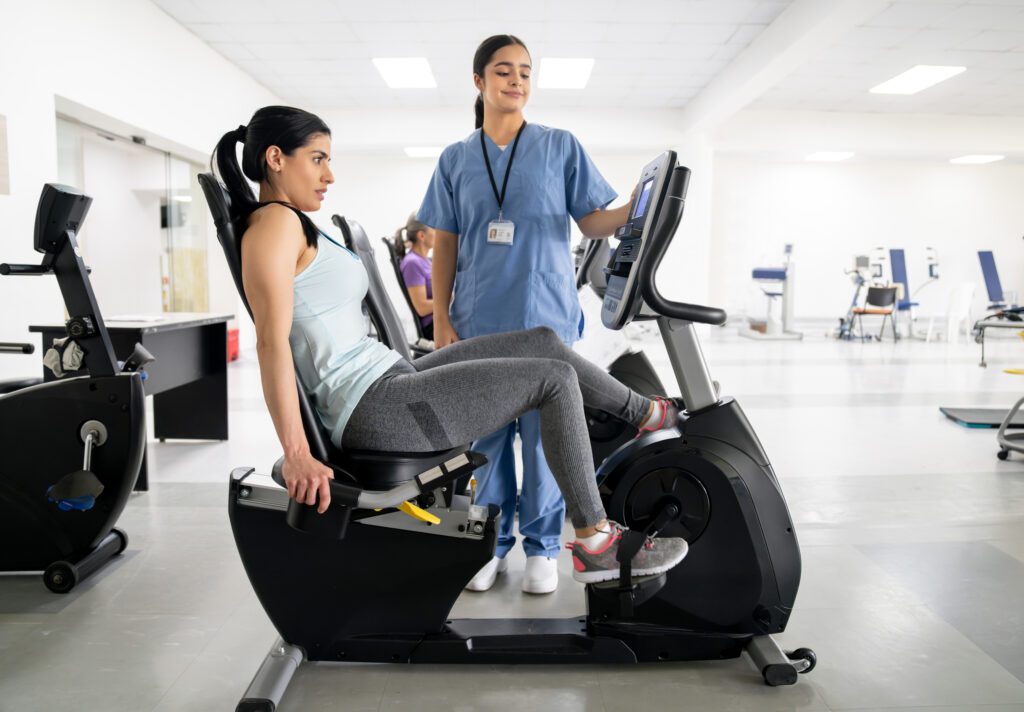
At Femina Physical Therapy, post-viral POTS rehabilitation follows the same patient-led principles as all our POTS care: a thorough evaluation first, visits that begin seated or partly reclined (semi-recumbent), continuous heart-rate and symptom monitoring, a short exercise portion that respects your energy limits (your ‘energy envelope’), and progression driven entirely by your response. The aim is to break the deconditioning cycle gently and rebuild tolerance, with the goal of improving your day-to-day function and quality of life.
“Pushing through is the wrong instinct. The program has to stay inside a sustainable limit and be expanded slowly.”
📍 Femina Physical Therapy treats POTS and orthostatic intolerance across Los Angeles, with offices in Sherman Oaks, Pasadena, and Beverly Hills. Telehealth and Coaching consultations are available for patients whose symptoms make travel difficult.
FAQ — PEOPLE ALSO ASK
POTS and POTS-like dysautonomia are recognized to follow viral illness in some people, and new cases have been widely reported after COVID-19. A proper medical work-up is important for new-onset symptoms, since diagnosis and medical management are done by your physician.
The core approach is the same graded, recumbent-first exercise program supported by randomized evidence in POTS. The main difference is extra emphasis on pacing, because post-exertional symptom worsening can be pronounced after a viral illness, making a sustainable ‘energy envelope’ especially important.
Delayed post-exertional worsening is common in post-viral dysautonomia, and a period of illness and rest also feeds the loss-of-fitness loop (deconditioning) that intensifies POTS symptoms. This is a physiological response, which is why paced, graded rehabilitation is the recommended path.
Generally, after a medical evaluation confirms it is appropriate, since new-onset symptoms need a work-up first. Rehabilitation itself can start gently, with seated or partly reclined (semi-recumbent) exercise, continuous monitoring, and progression driven entirely by how your body responds.
>> Living with POTS in Los Angeles? Recovery after a virus can be paced and measured. Book your evaluation at Femina Physical Therapy.
References (Peer-Reviewed Sources)
[1] (Class C) POTS: when dysautonomia misleads – a mechanistic argument for compensatory orthostatic tachycardia. Front Neurol. 2026. [frontiersin.org/journals/neurology/articles/10.3389/fneur.2026.1806502]
[2] (Class C) Joyner MJ, Masuki S. POTS versus deconditioning: the same or different? Clin Auton Res. 2008;18(6):300-307. [pmc.ncbi.nlm.nih.gov/articles/PMC3770293]
[3] (Class A) Fu Q, VanGundy TB, Shibata S, Auchus RJ, Williams GH, Levine BD. Exercise training versus propranolol in the treatment of the postural orthostatic tachycardia syndrome. Hypertension. 2011;58(2):167-175. [pubmed.ncbi.nlm.nih.gov/21690484]
[4] (Class A) Semi-supervised exercise training program more effective for individuals with POTS in a randomized controlled trial. (PMC10751269) [ncbi.nlm.nih.gov/pmc/articles/PMC10751269]
Related Reading: POTS & Orthostatic Intolerance at Femina Physical Therapy
→ Pacing, energy envelopes, and post-exertional symptom management
→ Working with your cardiologist: what PT does and doesn’t replace
→ Complete Guide: POTS & Orthostatic Intolerance Physical Therapy in Los Angeles (Pillar)
Medical disclaimer: This article is for informational purposes only and is not intended as medical advice. Always consult your medical doctor before beginning this or any program that may affect your health. Reading this article does not create a patient relationship with Femina Physical Therapy.